

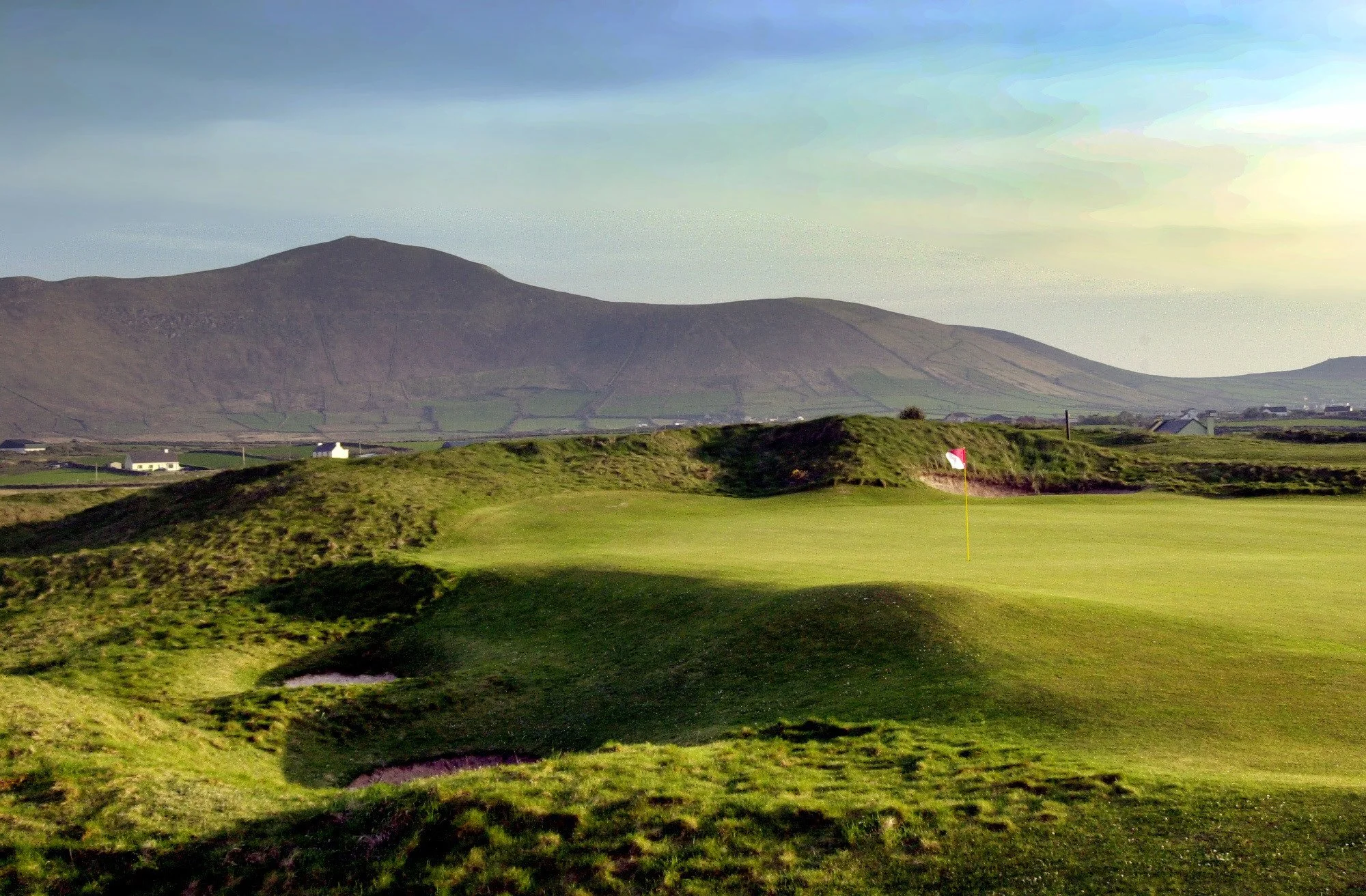
Dingle Golf Links / Golf Chumann Ceann Sibéal
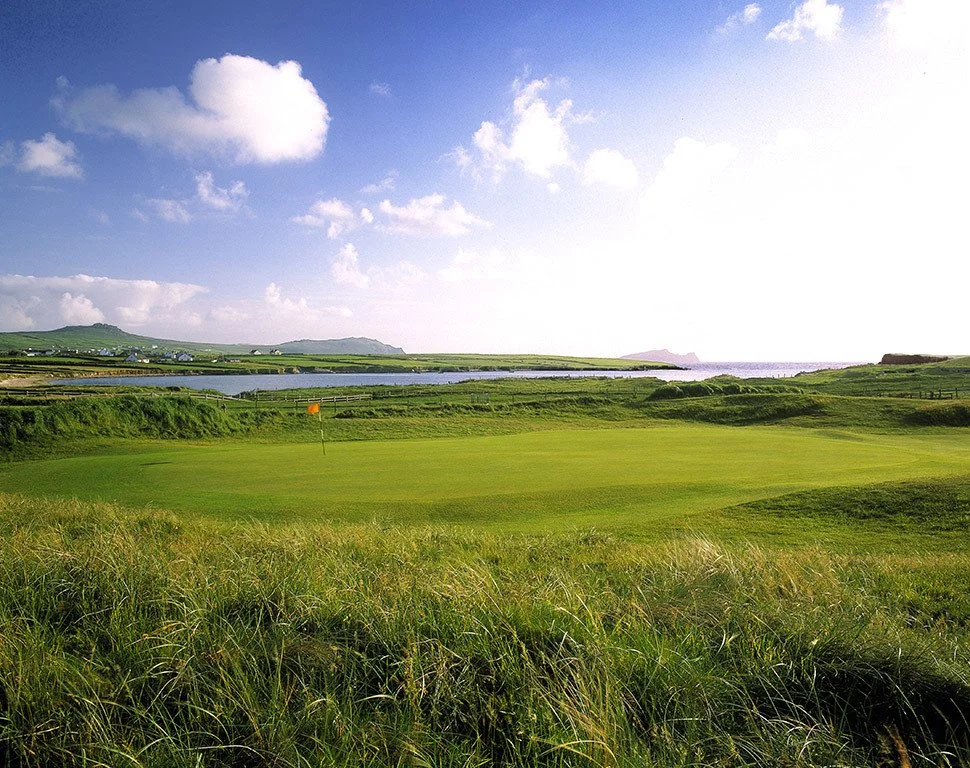
The Dingle Peninsula, a rugged protrusion of land into the Atlantic Ocean on Ireland’s southwest coast, serves as the geographical and cultural anchor for Dingle Golf Links, known natively as Galf Chumann Ceann Sibéal. This eighteen-hole championship links is not merely a sports venue but a complex intersection of minimalist golf architecture, Irish linguistic heritage, and dramatic geological history. Situated near the village of Ballyferriter in County Kerry, the course occupies a unique position as the westernmost golf course in Europe, a distinction that fundamentally dictates its relationship with the elements and its strategic character. The evolution of the club from its 1924 origins to its current state at the Ballyferriter site reflects a broader history of Irish golf, characterized by a transition from local leisure to international acclaim while maintaining a steadfast commitment to the natural landscape.
The structural identity of Ceann Sibéal is rooted in the design philosophy of Eddie Hackett, arguably the most influential golf architect in the history of the Irish republic. Hackett’s tenure in the 1970s, when the club relocated from its original nine-hole site east of Dingle town to the present Ballyferriter location, was defined by a rejection of the high-impact, earth-moving techniques that dominated American golf design during the same era.Hackett was a proponent of the "natural links," a style where the architect’s primary duty is to identify golf holes that already exist within the dunes and valleys rather than manufacturing them with heavy machinery.
Hackett’s work at Dingle is often contrasted with his larger-scale project at Waterville Golf Links. While Waterville features towering dunes and a more expansive, muscular layout, Ceann Sibéal exhibits a pastoral, subtle beauty that masks a high degree of tactical complexity.This minimalist approach was necessitated partly by modest budgets but primarily by a profound respect for the topography of the Corca Dhuibhne region. The lack of significant earth-moving resulted in fairways that follow the prehistoric undulations of the landscape, creating a playing surface where "blind" shots and unpredictable bounces are not flaws but integral features of the links experience.
In the 1990s, the course underwent a series of refinements under the guidance of Christy O’Connor Jnr.O’Connor Jnr, a figure of immense standing in professional golf, brought a championship sensibility to the layout, ensuring that the course could challenge the modern professional while retaining the playability valued by the club’s membership. O’Connor Jnr was famously enthusiastic about the site, suggesting that Ceann Sibéal possessed every essential quality found at St. Andrews, supplemented by the dramatic visual backdrop of the Kerry coastline.
The Restaurant and Bar
Dingle Golf Links clubhouse restaurant is situated on the upper floor to provide panoramic views of the entire eighteen-hole layout, the Atlantic Ocean, and the Blasket Islands. The menu emphasizes local provenance, utilizing ingredients sourced from the surrounding land and sea.
Dining Concept: Award-winning bar and restaurant offering an a la carte menu and daily specials.
Special Services: Early breakfast can be arranged for golfers with morning tee times by contacting the catering manager.
Atmosphere: Known for its "warm Irish hospitality" and "the best of craic," making it a popular spot for both players and locals.
The Siopa Galf (Pro Shop)
The Pro Shop, or Siopa Galf, provides a full suite of services required for a coastal links round. Given the variable weather, the shop stocks a significant range of technical apparel and high-quality equipment.
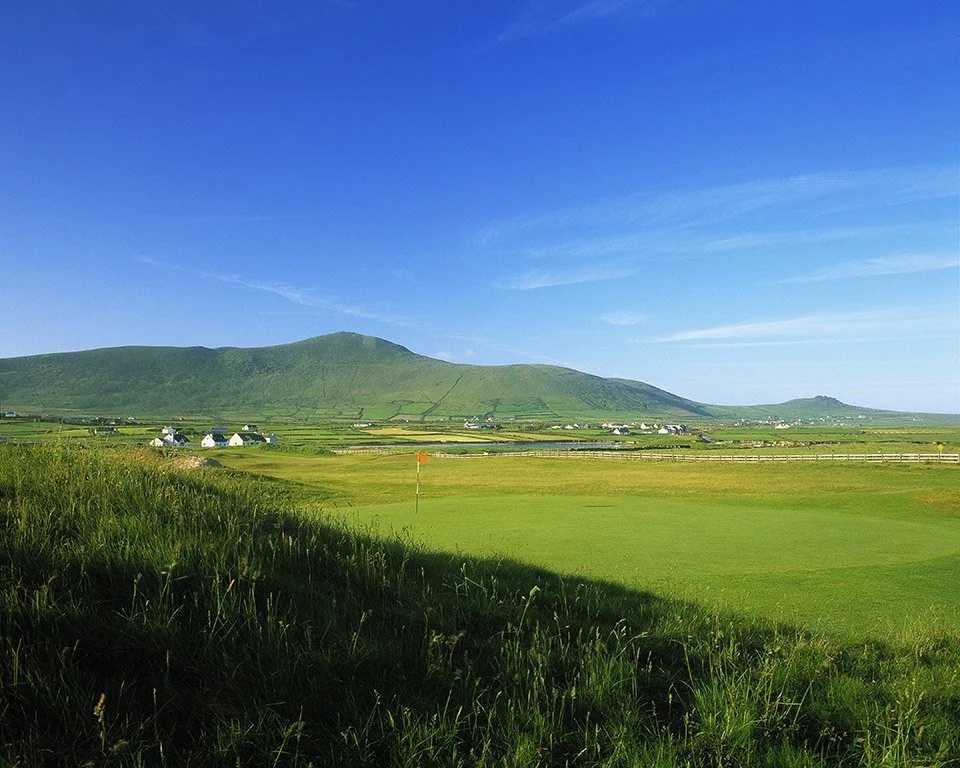
Dingle Golf Links Front Nine: The Low-Lying Linksland
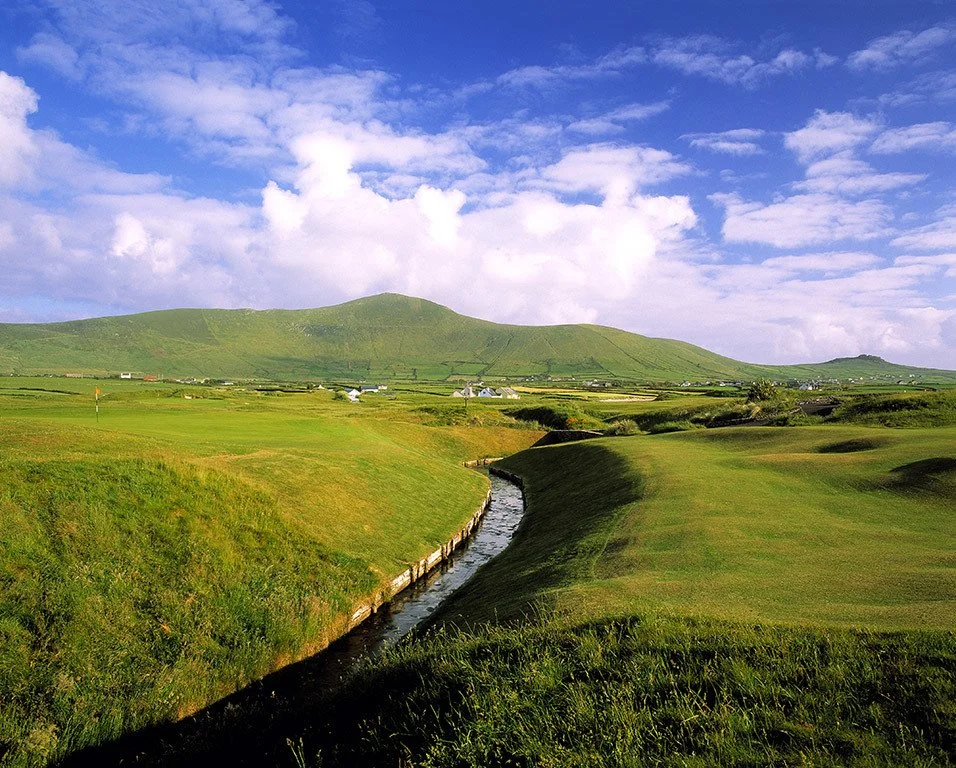
Hole 1: Poll na Cruaiche (Hole of the Stack) Par 4, 397 yards, Index 9 The opening hole is a stark introduction to the influence of the Burn. From the clubhouse, which sits at the highest point of the property, the golfer looks down into a valley where three fairway bunkers guard the landing area. The approach must carry the stream, which cuts through a deep gorge immediately in front of the green. Any shot falling short is liable to roll backward into the water due to the steep, manicured bank.
Hole 2: Poll an tSéaláin (Hole of the Strainer) Par 3, 218 yards, Index 11 A long par 3 that exemplifies the challenges of coastal wind. Deep bunkers protect the front of the green, while steep run-offs and thick marram rough await any shot that fails to find the putting surface.It requires a piercing ball flight to navigate the gusts often blowing in from the Blasket Sound.
Hole 3: Sibéal (Elizabeth) Par 4, 364 yards, Index 3Named for the local headland, this hole demands a drive that carries the burn to reach the fairway. The hole plays entirely uphill from the drive, making the 364 yards play significantly longer. The Burn continues to wind up the right-hand side, penalizing any slice.
Hole 4: Poll an Phíobaire (The Piper’s Hollow) Par 4, 371 yards, Index 15 A relatively generous landing area off the tee box provides a brief respite, but the approach is fraught with danger. The Burn lurks in the long grass to the right, and a solitary pot bunker guards the left side of the green. Accuracy is prioritized over power here.
Hole 5: An Giolcach (The Reedy Place) Par 3, 186 yards, Index 13 This hole marks a turn toward Mount Brandon, changing the wind’s influence from a cross-breeze to a head or tailwind. The green is well-protected and features subtle breaks that reflect the underlying sandy soil of the linksland.
Hole 6: Gorta Dubha (The Black Sod) Par 5, 547 yards, Index 7 The longest hole on the front nine, this par 5 plays northward toward the Three Sisters. Out of bounds lines the entire right side, and the breeze typically blows off the Atlantic, pushing balls toward the hazard. The green is heavily bunkered, requiring three precise shots to reach.
Hole 7: An Mionnán (The Kid Goat) Par 4, 356 yards, Index 5 The course’s first true dogleg requires a placement-oriented drive. The green slopes severely from right to left, and any approach shot that misses on the high side will likely find a collection of deep bunkers.
Hole 8: Na Deifréaracha (The Sisters) Par 4, 356 yards, Index 17 Named for the adjacent cliff peaks, this hole features a significant carry off the tee. The green is protected by a deep furrow across its front, a natural depression that prevents low-running approaches from reaching the pin, effectively forcing an aerial attack despite the wind.
Hole 9: Ifreann (Hell) Par 4/5, 442 yards, Index 1Appropriately named, this is the most difficult hole on the course for men. The Burn cuts diagonally across the fairway roughly 200 yards from the back tees. Success requires a heroic carry followed by an exhausting uphill approach to a green situated near the clubhouse.
Dingle Golf Links Back Nine: The Elevated Dunes and Historic Markers
Hole 10: An Tiaracht (The Westerly) Par 3, 215 yards, Index 8 The signature hole of the inward half is a par 3 played to a blind, elevated green nestled in front of a massive sand dune. A semi-circle of pot bunkers protects the right side. The view from this green encompasses the entirety of the peninsula, providing one of the most iconic vistas in Irish golf.
Hole 11: Coillteán (The Little Wood) Par 5, 572 yards, Index 16 A dogleg left that initiates at the course’s highest elevation. The strategic play is to aim right of the bridge for safety. The hole then descends, offering a potential birdie opportunity if the wind is favorable, though the length remains a significant defense.
Hole 12: Túirnín (The Little Spinning Wheel) Par 3, 176 yards, Index 10 Played from an elevated tee, this hole is framed by four bunkers. Its most significant feature is the herringbone stone wall running along the right side, a relic of the Great Famine. This wall serves as both a boundary and a somber historical reminder.
Hole 13: Casadh Cosaí (Crosaí’s Corner) Par 5, 509 yards, Index 2 Named after greenkeeper Muiris Crosaí, this dogleg right is a strategic masterpiece. The Burn crosses the line of play twice. Golfers must decide between a 240-yard minimum carry over the corner or a conservative three-shot strategy. The uphill approach is notoriously difficult to hit in two shots due to the prevailing wind.
Hole 14: Binn Bhreac (The Speckled Peak) Par 4, 374 yards, Index 18 A downhill hole where the natural undulations of the fairway can either help or hinder the ball’s progress toward the green. A subtle mound protects the green, reflecting Hackett’s skill in using minor topography to create major strategic questions.
Hole 15: An Eascú (The Eel) Par 4, 448 yards, Index 4 A long, demanding par 4 that requires a perfectly straight tee shot. The raised green is exceptionally difficult to hold with a long-iron or fairway-wood approach, making this one of the sternest tests on the back nine.
Hole 16: Comharsain Phiarais (The Neighbors of Piaras) Par 4, 400 yards, Index 12 A slight dogleg right requiring a precise drive to find the correct angle for a diagonal green. In the dry summer months, the firmness of the links makes this green particularly difficult to hold, rewarding those who can play the "bump and run".
Hole 17: Buailtín (The Little Milking Place) Par 4, 468 yards, Index 6 A massive par 4 that requires a long carry from the back tees. After finding the fairway, the player must navigate the Burn one final time, along with four greenside bunkers, to reach the putting surface.
Hole 18: An Clabhsúr (The Conclusion) Par 5, 551 yards, Index 14 The finishing hole is a grand uphill par 5. Fairway bunkers are strategically placed to catch errant drives. A unique turf wall sits 90 yards from the green, forcing a lofted approach to an enormous putting surface guarded by a deep pot bunker on the left.