

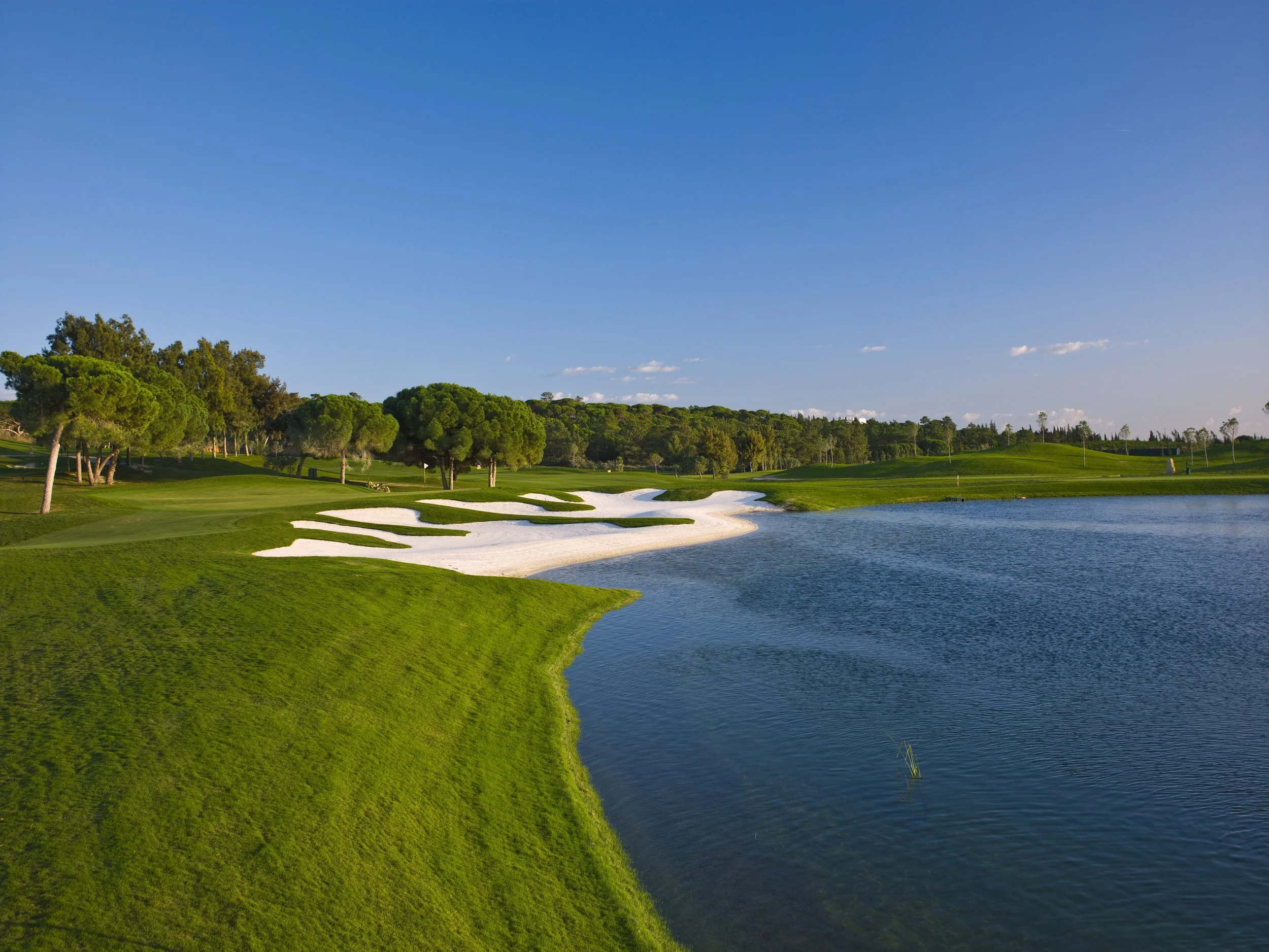
The Jewel of the Ludo Valley: Laranjal Golf Course.
The reputation of Laranjal Golf Course is built largely on its conditioning. It is frequently cited in player reviews as being "immaculate" and the "best condition" of the three Quinta do Lago courses. This is the result of specific agronomic choices and high-intensity maintenance regimes.
As the name suggests—"Laranjal" translates to "Orange Grove" in Portuguese—the land was originally a massive orange plantation.
In the late 2000s, the Quinta do Lago resort decided to build a third championship course to complement its famous North and South courses. They selected the Ludo Valley, a site roughly 2km east of the main resort, known for its rolling terrain and rich soil.
Laranjal Golf Course is located in the Quinta do Lago estate, which is a straightforward 15–20 minute drive (approx. 12 km) from Vilamoura. It is very accessible for golfers based in Vilamoura, with many using Ubers or transfer shuttles to get there quickly.
Because of its history, the course is defined by what was left behind: you are constantly playing among umbrella pines, cork oaks, and the signature orange trees that still line many fairways.
Since opening in 2009, it has developed a reputation for having some of the purest, fastest greens in the Algarve, often outperforming its older sibling courses in terms of condition
Designer: Jorge Santana da Silva Opened: 2009
Course Length
White Tees (Men's Club): Approx. 6,061 meters (6,628 yards)
Gold Tees (Championship): Approx. 6,480 meters (7,086 yards)
Red Tees (Ladies): Approx. 4,808 meters (5,258 yards)
The Unique Par Layout (Par 72) The Golf Course is famous for having a distinctive layout that differs from the standard "10 par 4s" setup. It features an even mix of 5 Par 3s and 5 Par 5s

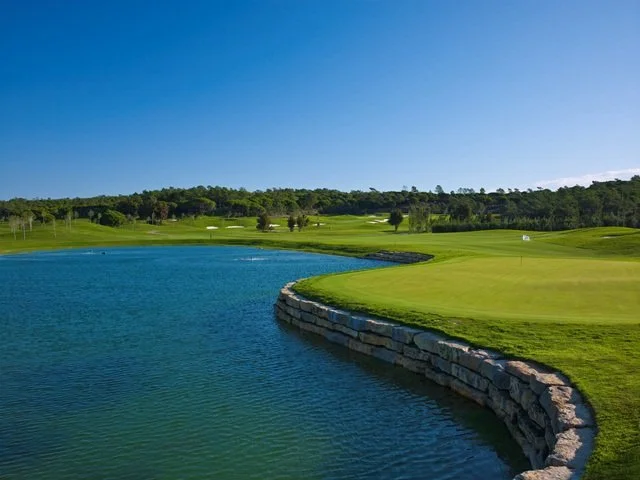
Detailed Hole-by-Hole Analysis
The routing of Laranjal Golf Course is a journey that twists through the orange groves, constantly changing direction to ensure that the prevailing wind affects the golfer from all angles.
The Outward Nine: Establishment of Precision
Hole 1: The Awakening (Par 4, ~370m) The opening hole sets the tone. It is not an overly long Par 4, but the fairway corridors are defined by the tree lines. The approach is to an elevated green, a common theme on the course. The elevation ensures that any shot coming up short is rejected, demanding that the player strikes their first iron shot of the day with commitment.
Hole 2: The Beach (Par 3, ~210m) This is the first major test and a candidate for a signature hole. Playing around 210 meters from the back tees, it requires a long iron or hybrid. The defense is a massive "beach-style" bunker that guards the front and side of the green. The visual intimidation is high; the sand seems to merge with the green complex, making the target appear smaller than it is. Par here is an excellent score that stabilizes the round.
Hole 3 - 6: The Corridor Run This sequence weaves through the densest part of the cork oaks. The fairways here are noted for being narrow.
Hole 3 (Par 4) and Hole 4 (Par 4) require distinct shaping off the tee. The trees are not merely decorative; they overhang the ideal flight lines, punishing players who hit straight but on the wrong side of the fairway.
Hole 5 offers a respite as a shorter Par 4, but the green contours are severe.
Hole 6 is a mid-length Par 3 that requires precision over power.
Hole 7: The Titan (Par 3, ~236m) Ideally played from the elevated tees, Hole 7 is one of the longest Par 3s in Portugal. Measuring 236 meters from the tips, it is effectively a "Par 3.5." Into the wind, this is a driver for many amateurs. The green is large to accommodate the long approaches, but three-putts are common due to the size of the surface.
Hole 9: The Risk-Reward Climax (Par 5, ~470m) The front nine concludes with a spectacular Par 5 that encapsulates the "risk-reward" philosophy.
The Tee Shot: A dogleg left. Players must decide how much of the corner to cut. The inside line is guarded by trees, while the safe line to the right runs out of fairway.
The Second Shot: This is the defining moment. A large lake guards the right side of the green and the approach area. The player who has driven well faces a dilemma: hit a high fairway wood over the water to a shallow green, or lay up to a wedge distance. The water hazard is extensive, swallowing any shot that leaks right.
The Green: Fast and sloping towards the water. Even a safe layup requires a nerve-wracking wedge shot to a pin that often looks like it is floating.
The Inward Nine: Water and Drama
Hole 10: The Reset (Par 4, ~300m) The back nine opens with a shorter Par 4. It tempts the long hitter to drive the green, but the narrow neck of the fairway and greenside bunkering punish the ego. It is a strategic "teaser" before the heavy lifting to come.
Hole 11: The Lake's Edge (Par 4, ~288m) Visually, this is one of the most stunning holes on the Algarve coast. It is a short Par 4 (drivable for some from forward tees), but it is flanked entirely down the right side by a large lake.
The Hazard: A sweeping beach bunker runs the entire length of the water line, separating the fairway/green from the liquid hazard.
Strategy: The "safe" play is to aim left, away from the water. However, the further left you go, the longer and more angular the approach becomes. The aggressive play hugs the water/bunker line, leaving a mere flick with a wedge. It is a masterclass in psychological design—the hole is short, but the penalty for greed is absolute.
Hole 12 - 15: The Technical Core The middle of the back nine requires concentration as fatigue sets in.
Hole 13 (Par 5) allows for recovery, offering a wide fairway, but fairway bunkers are placed exactly at the landing zones for the average drive.
Hole 14 (Par 4) features a well-defended green that rejects low shots.
Hole 16: The Double Dogleg (Par 5, ~544m) Often cited as the most difficult hole on the course, this Par 5 is a true three-shot test.
The Layout: The hole snakes through the landscape, doglegging right then left (or vice versa depending on the angle).
The Hazards: Water runs down the right side off the tee. The second shot must navigate a narrowing fairway.
The Approach: The green is elevated and fronted by a small lake. To reach it in two requires a carry over water to a small, raised target—a shot with a very low success rate for amateurs. The disciplined play is to lay up short of the water, leaving a full wedge to the elevated surface.
Hole 17: The Calm Before the Storm (Par 4, ~281m) A final short Par 4. It looks innocuous, but the green is one of the most undulating on the course. A poor approach leaves a defensive putt that can easily lead to a bogey.
Hole 18: The Grandstand Finish (Par 5, ~475m) The round concludes with a reachable Par 5 that plays towards the clubhouse.
The Drive: Must thread the umbrella pines.
The Approach: The green sits in a natural amphitheater below the clubhouse terrace. Spectators enjoying post-round drinks have a clear view of the 18th green, adding a layer of performance pressure to the final putts. It is a heroic finish that often decides matches.
Laranjal Golf Course should be at the top of your list on a golf trip to the Algarve.

Laranjal Golf Course Practice Infrastructure
Laranjal’s isolation necessitated its own practice grounds, ensuring players do not need to shuttle from the main resort.
Driving Range: A full-length range is located adjacent to the clubhouse (noted as "across the road" in some reviews). It operates from 7:00 to 16:00 (with maintenance closures on specific mornings), allowing for comprehensive warm-ups.
Short Game Area: The chipping and putting greens are maintained to the same Penn A4 standards as the course, providing an accurate gauge of green speeds before the round.
The service ethos is "member-for-a-day." Staff assist with bag drops and buggy preparation.
Pro Shop: Stocked with high-end apparel and equipment, open from 8:00 to 20:00.
Rentals: The latest TaylorMade or Callaway clubs are typically available for hire, along with electric trolleys and GPS-equipped buggies.